 Neopolis Infra
Landlord Share Flats in Hyderabad: The Complete 2026 Buyer's Guide
A landlord share flat is one of the best-kept value secrets in the Hyderabad property market: the same apartment, in the same tower, with the same amenities as the unit next door — often for 8 to 14 percent less. Yet most buyers either haven't heard of it or worry it is somehow risky. This complete 2026 guide explains exactly what a landlord share (landowner's share) flat in Hyderabad is, why it costs less, whether it is safe and legal, how much you can save, and the precise steps and checks to buy one with total confidence.
What is a landlord share flat in Hyderabad?
Most large residential projects in Hyderabad are built as joint developments. The landowner contributes the land; a developer builds the towers; and under a registered Joint Development Agreement (JDA), the finished flats are divided between the two parties in an agreed ratio — commonly leaving the landowner with something like 30 to 45 percent of the units.
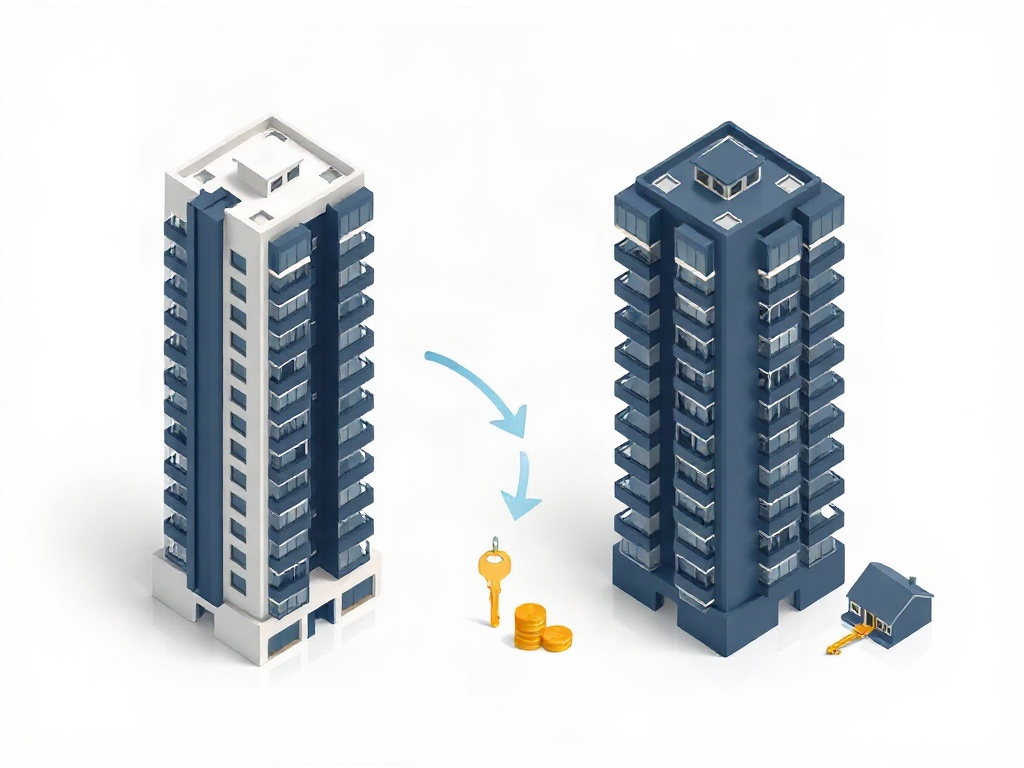
The developer sells its share at card rate through the project sales office — the price you see advertised. The landowner's share — the "landlord share" — is sold separately, usually through specialist desks that hold that inventory rather than through the sales office. A landlord share flat is therefore not a different or inferior product. It is a normal flat in the same project, simply allocated to the landowner under the development agreement instead of to the builder.
Why are landlord share flats cheaper?
The saving is not a discount or a distress sale — it comes from a genuinely different cost basis. The developer prices its units to recover construction, marketing, brand premium, sales-team costs and target margin. The landowner's cost basis is essentially the land they already owned. With no long broker chain and no builder marketing loaded on top, the landowner can sell the same unit for less and still do well.
In practice, a correctly bought landlord share flat in Hyderabad typically costs 8 to 14 percent below a comparable resale or builder-sold unit in the same project. On a ₹1.5 crore flat that is roughly ₹12 to 21 lakh — real money on a single purchase. Our deeper comparison, landlord share vs resale vs builder price, breaks down exactly where that gap comes from.
Is a landlord share flat safe and legal?
This is the question every buyer asks, and the honest answer is: the concept is not the risk — unverified paperwork is. A landlord share flat with a verified JDA allocation and a clean title is, after registration, legally identical in ownership terms to any other flat. You get a registered sale deed in your name exactly as you would buying from the builder.
The reason some buyers have heard cautionary stories is that a minority of transactions were done without proper verification — buying a unit before confirming it actually sat in the landowner's allocation, or without checking the title on the parent land. Those are avoidable process failures, not a flaw in the landlord share model. The whole point of buying through a desk that verifies allocation and title before listing a unit — as Neopolis Infra does — is to remove exactly that risk. Get the verification right (the checklist is below) and a landlord share purchase is as safe as any other registered flat purchase in Hyderabad.
How much can you save? A quick example
| Item | Builder / resale unit | Landlord share unit |
|---|---|---|
| Same tower, same 3 BHK | ✔ | ✔ |
| Same amenities & spec | ✔ | ✔ |
| Indicative price | ₹1.50 Cr | ₹1.29–1.38 Cr |
| Typical saving | — | 8–14% (≈ ₹12–21 lakh) |
| Ownership after registration | Registered sale deed | Registered sale deed (identical) |
The figures are illustrative — your actual saving depends on the project, tower, floor and the specific unit — but they show the shape of the opportunity: an identical home, a materially lower price, and the same legal ownership at the end.
Where to find landlord share flats in West Hyderabad
Landlord share inventory exists right across West Hyderabad's growth corridors, and the right corridor depends on your budget, commute and priorities. Each of our corridor guides covers current prices and the landlord share options there:
- Kokapet — the premium, highest-appreciation corridor anchored by the Neopolis layout.
- Financial District belt — the office-core catchment (Nanakramguda, Kokapet, Narsingi).
- Narsingi — real ORR connectivity and the deepest supply at a mid price.
- Manchirevula — a near-premium, quieter pocket between Kokapet and Narsingi.
- Tellapur — bigger homes for the money, a little further out.
- Kollur — the value and investment frontier on the ORR.
For a side-by-side view of prices across all of them, see our West Hyderabad 2026 price guide.
How to buy a landlord share flat safely: step by step
- Fix your budget and get a loan pre-approval. Banks lend on landlord share units once the allocation and title documents are verified, so being pre-approved lets you negotiate as a ready buyer.
- Shortlist units across at least two projects. Compare carpet area (not just super built-up), floor, facing and total cost including parking, amenities and GST where applicable.
- Confirm the unit is genuinely a landowner-allocated unit. Ask for the registered JDA and its unit-allocation schedule; your exact flat number must appear in the landowner's share, and the seller must be that landowner or their authorised representative.
- Verify the title and encumbrance. Get an independent legal opinion on the parent land's title chain and confirm the unit is free of mortgages or liens (an Encumbrance Certificate helps).
- Check RERA and approvals. Confirm the project's RERA registration (and phase-wise registration where applicable) and that HMDA/GHMC sanctioned plans match what is built; check the occupancy certificate for ready buildings.
- Agreement of sale, then registration. Standard sub-registrar process. NRIs can complete most steps remotely through a registered Power of Attorney — see our NRI buying guide.
- Take possession formally. Snag the unit, confirm amenity handover, and collect the complete document set.
The verification checklist (keep this beside you)
Before any token or advance changes hands, confirm every one of these:
- Registered Joint Development Agreement and any supplementary agreements.
- The unit-allocation schedule naming your exact flat in the landowner's share.
- Independent legal opinion on the parent-land title chain.
- Encumbrance Certificate confirming no mortgages or liens on the unit.
- RERA registration (and phase-wise registration where applicable) with the committed possession date.
- HMDA / GHMC sanctioned plans matching the constructed building.
- Occupancy Certificate for ready buildings.
- Property-tax and utility dues cleared.
- Seller's identity and authorisation (that they are the landowner or their authorised representative).
If any single document is missing or "coming soon," pause the transaction until it exists. A genuine seller will never resist verification — and a desk that has already done this work before listing saves you the effort while removing the risk.
Common landlord share disputes — and how to avoid them
The disputes buyers worry about almost always trace back to a skipped check, and each has a simple preventive:
- "Is this unit really the landowner's?" — Prevented by matching your flat number against the registered JDA allocation schedule before you pay anything.
- Title or encumbrance problems on the parent land — Prevented by an independent legal opinion and an Encumbrance Certificate.
- Developer–landowner disagreements over allocation — Prevented by buying only a unit whose allocation is clearly documented and, ideally, acknowledged by both parties.
- Possession or handover delays — Prevented by checking the RERA-committed date and, for ready units, the Occupancy Certificate.
Do these four things and the "landlord share risk" you may have read about simply does not apply to your purchase.
Home loans on landlord share flats
A frequent myth is that banks won't finance landlord share units. They will. Major banks and housing-finance companies lend on landlord share flats once the allocation and title documents are in order — which is the same verification you should insist on regardless of financing. In fact, a bank's own legal and technical due diligence acts as a useful second check on the paperwork.
Myths vs facts
"Landlord share flats are legally weaker." After registration you hold a registered sale deed exactly like any other buyer — ownership is identical.
"You can only buy from the builder's sales office." The office sells the builder's share. The landowner's share sells separately, often at better prices, through desks that hold that inventory.
"The saving means lower quality." It is the same tower and the same specification — the price gap reflects cost basis, not build quality.
"Banks won't give a loan." They do, once allocation and title are verified.
"It's too complicated." With a verified allocation and a clear checklist, the process is the standard flat-purchase flow — and buying through a desk that pre-verifies removes most of the legwork.
Frequently asked questions
What is a landlord share flat in Hyderabad?
It is a flat allocated to the landowner (rather than the builder) under a registered Joint Development Agreement. It is the same apartment, in the same tower, with the same amenities as builder-sold units — sold separately, usually 8–14% below comparable resale.
Is it safe to buy a landlord share flat?
Yes, when the paperwork is verified. With a confirmed JDA allocation and a clean title, a landlord share flat is legally identical to any other flat after registration. The risk lies only in skipping verification — which a specialist desk does for you before listing.
Why are landlord share flats cheaper?
The landowner's cost basis is the land they already owned, with no builder marketing or long broker chain loaded on top, so the same unit can be sold for less — typically 8–14% below a comparable resale or builder price.
Can I get a home loan on a landlord share flat?
Yes. Major banks lend on landlord share units once the allocation and title documents are verified.
Can NRIs buy landlord share flats in Hyderabad?
Yes, under standard FEMA rules for residential property. Shortlisting, verification, Power of Attorney and registration can be handled largely remotely.
How do I check if a flat is really a landlord share unit?
Ask for the registered JDA and its unit-allocation schedule — your exact flat number must appear in the landowner's allocation, and the seller must be that landowner or their authorised representative.
The bottom line
A landlord share flat in Hyderabad is not a loophole or a gamble — it is simply the landowner's half of a joint development, the same home at a lower price because of a lower cost basis. Buy one with the allocation and title verified, and you get an identical apartment, an identical registered title, and a saving of 8 to 14 percent that goes straight into your pocket.
Neopolis Infra specialises in exactly this: verified landlord share inventory across six West Hyderabad corridors — Kokapet, the Financial District belt, Narsingi, Manchirevula, Tellapur and Kollur — with the JDA allocation and title checked before a unit is ever listed, typically priced 8–14% below comparable resale. Inventory and pricing move quickly, so current details should always be confirmed with the team. Message Neopolis on WhatsApp to see verified landlord share flats in your budget, or explore all projects across West Hyderabad.
Featured landlord-share projects we cover
Neopolis Infra represents landlord-share (landowner-share) units across leading West Hyderabad developments — the same flats, direct-priced 8–14% below builder rates. Projects include Rajapushpa Pristinia · MoonGlade · Vasavi Atlantis · Aparna Zenon · Rajapushpa Greendale · Rajapushpa Infina. See all projects →
Tell us your corridor and budget — we reply on WhatsApp, usually within the hour.
Chat on WhatsApp →